
pTreks: The Genesis of a Modern Platform for Group Exploration
Welcome to the official introduction of the pTreks adventure platform. This is our home for sharing deep technical milestones and platform updates alongside scenic adventure reports, ride logs, and stories from our group outings. Our goal is simple: to share everything related to the thrill of group adventuring and the modern technology that supports it.
1. The Call of the Open Road & Backcountry Trails: Where Logistics Meet Freedom
If you have visited our website, you will immediately recognize the core spirit that guides everything we build: a visual promise of the open road, deep backcountry trails, and rugged summits - heading into places unknown with a sense of pure freedom, balanced by the premium design of a modern adventure platform.
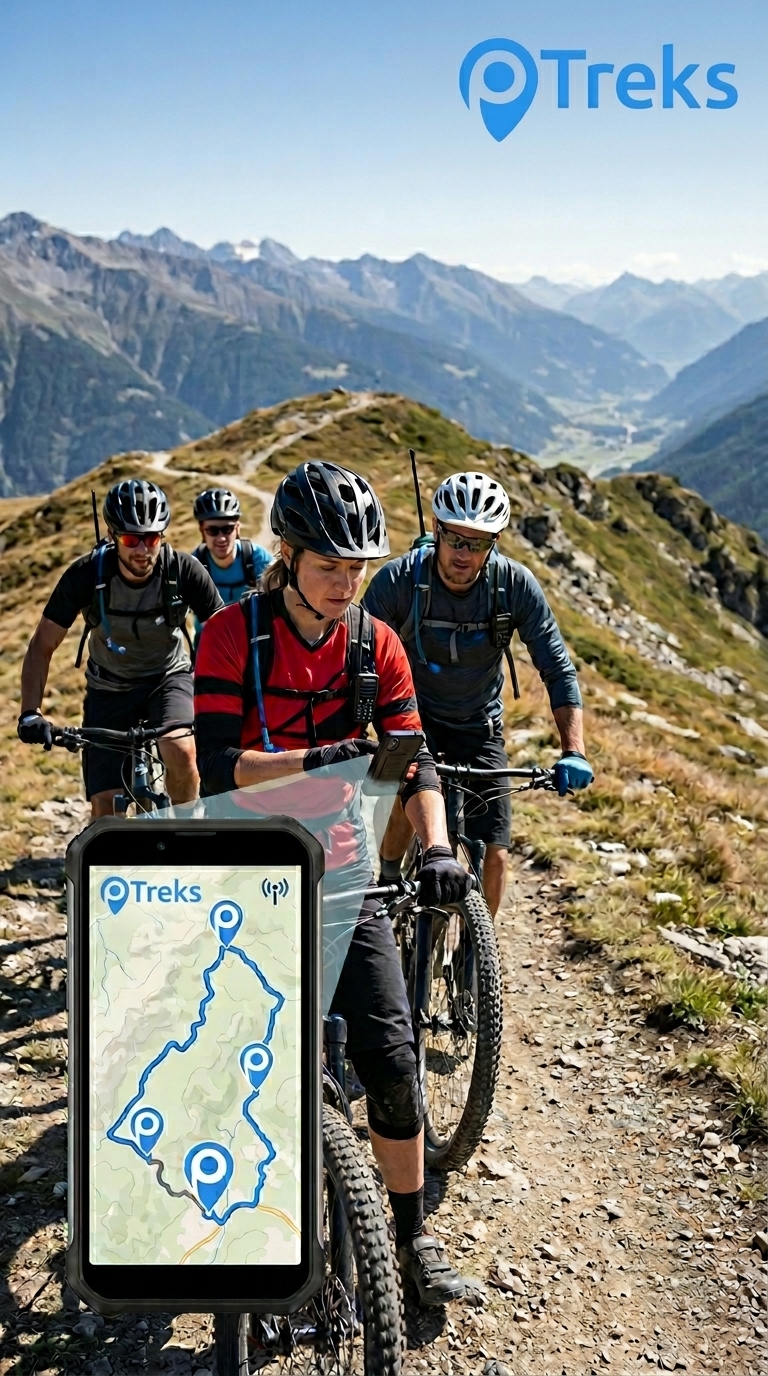
Mountain trekking with pTreks - friends on the trail, connected in the wild.
Whether your group is backpacking a high-elevation alpine ridge, climbing a sheer granite wall, cycling through winding coastal routes, or navigating remote dirt trails on adventure motorcycles, the fundamental thrill of exploration is profoundly rewarding. However, these excursions also highlight the significant, recurring challenges of group coordination in the wild.
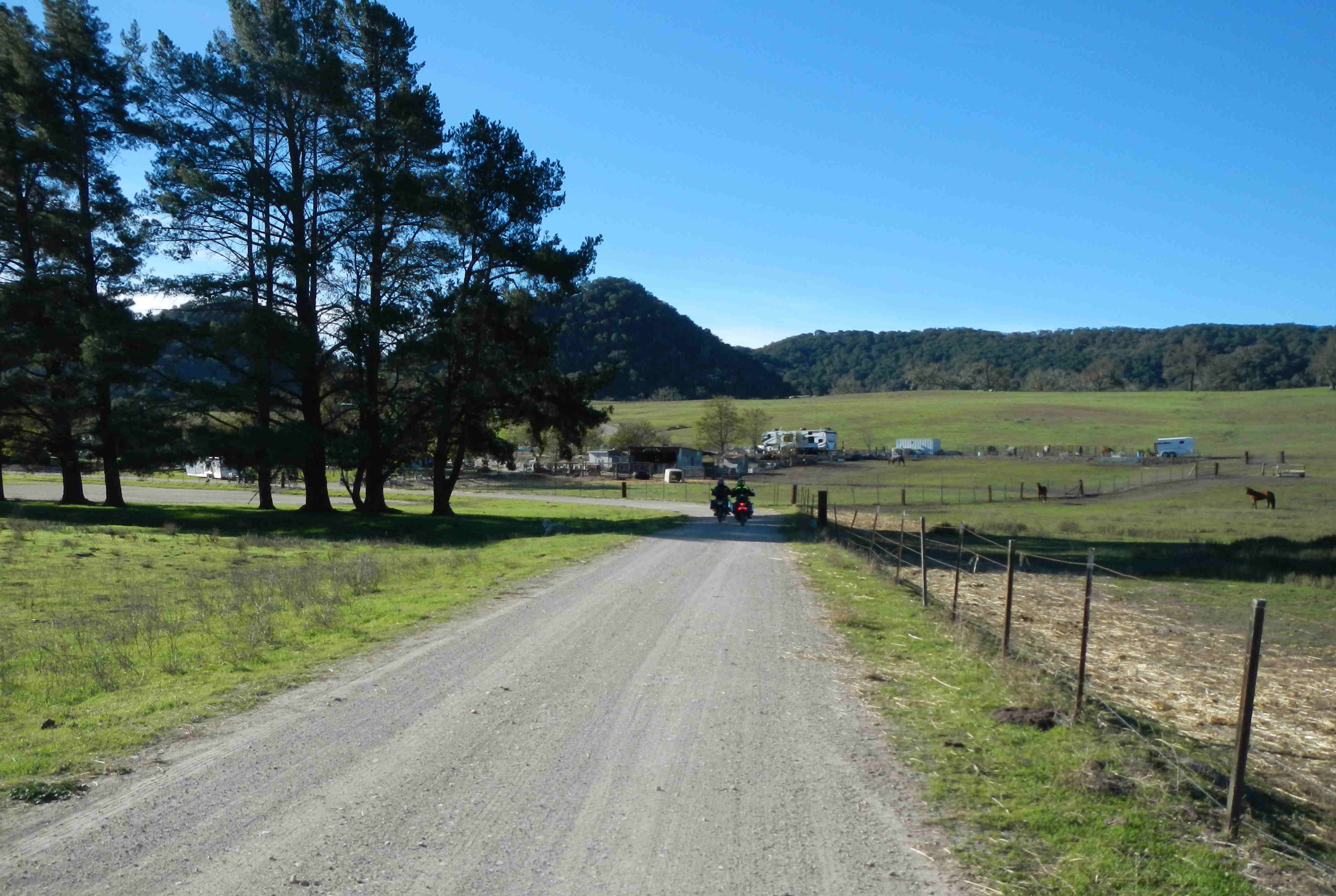
The majestic call of the open road: heading into places unknown with a sense of pure freedom.
Before the first boot hits the trail or a wheel turns, a group organizer must navigate a complex logistical checklist:
- Pre-Trip Alignment: Announcing the itinerary, distributing route specifications, and collecting participant RSVPs.
- Safety Preparedness: Securing essential contact details and critical In Case of Emergency (ICE) information for every participant.
- Day-of Execution: Managing headcounts, coordinating departure schedules, and ensuring no participant is left behind at the starting line.
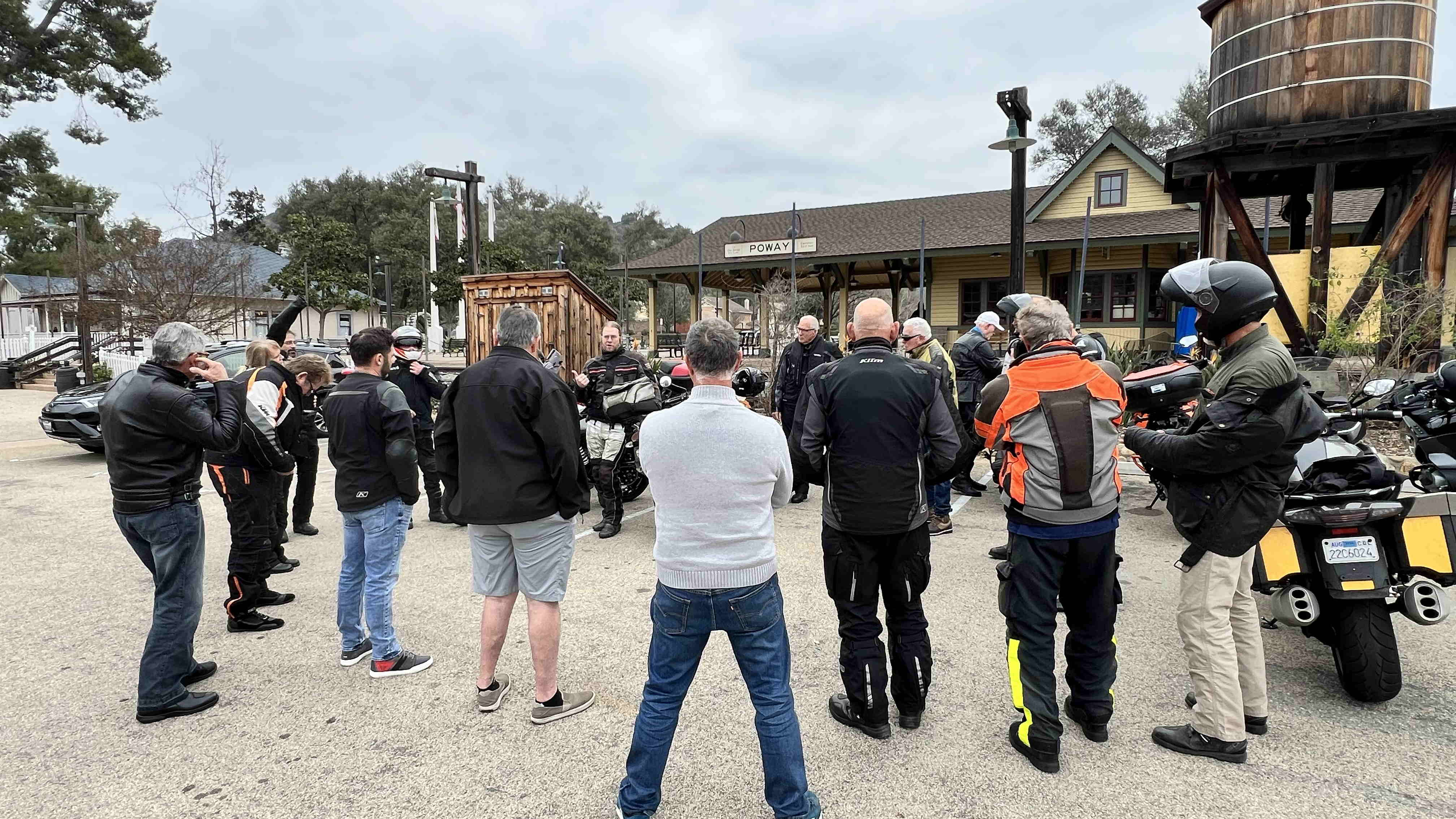
A critical pre-ride briefing: organizing route specifications, headcounts, and safety protocols before launching into the field.
Once the journey begins, new operational risks emerge. Late arrivals can disrupt tight schedules, participants frequently lose visual contact in dusty, winding, or dense terrain, and unexpected issues - such as minor falls, low fuel, gear failures, or navigation errors - are common in remote environments.
For years, we asked ourselves: How can we leverage technology to simplify this operational burden and make group adventures safer and more connected?
The answer is pTreks.
.png)
2. The Historical Evolution of pTreks: 2010 to Present
The conceptual roots of pTreks date back to 2010. Combining a long-standing professional fascination with biological motor mechanics and feed-forward networks alongside a strong background in software engineering and entrepreneurship, I began exploring the capabilities of the early iPhone SDK. I quickly recognized that the newly introduced onboard accelerometers had immense potential far beyond simple screen-rotation. I envisioned an automated system engineered to monitor distinct deceleration events and high-G impact signatures to intelligently activate emergency dispatch and real-time team notifications.
In 2012, this concept expanded into a comprehensive requirements specification for a peer-to-peer assistance network. The exact vision statement from my 2012 design documentation laid out the closed-loop system model:
The vision is to create an iOS iPhone application that can assist a person disabled while traveling in a vehicle (motorcycle, bicycle, car, truck, off-road, boat, etc.) or without a vehicle (walking, running, climbing, skiing, etc.) through smartphone technology that combines location-aware services provided through its sensors for GPS, accelerometer and magnetometer. The application operates within a closed-loop system to reference other persons using the same system that can provide personal human-based assistance to the person requiring assistance.
Under this design, travelers who encountered trouble in the field (designated as “explorers seeking assistance”) would be systematically matched with nearby companions (“supporting companions”) who had the tools and willingness to assist (for example, matching a cyclist stranded with a flat tire to a companion carrying a spare inner tube, or a motorcyclist with a puncture to a rider with a tire pump). To address the major battery-drain limitations of constant GPS polling on 2012-era smartphone hardware, the specifications established a probability mapping algorithm. Instead of continuous background GPS tracking, the system grouped users into distinct speed categories to determine dynamically calculated distance and time update thresholds. For example, a motorcyclist’s position updated on a grid 15 miles wide every 15 minutes, whereas a hiker’s updated on a grid a half-mile wide, maximizing battery efficiency while guaranteeing location accuracy within minutes of an emergency trigger.
I coordinated with one talented iOS developer to construct the initial client prototype. Unfortunately, demanding executive commitments in my other medical-field start-up ventures temporarily sidelined the project, and the application never saw a public release.
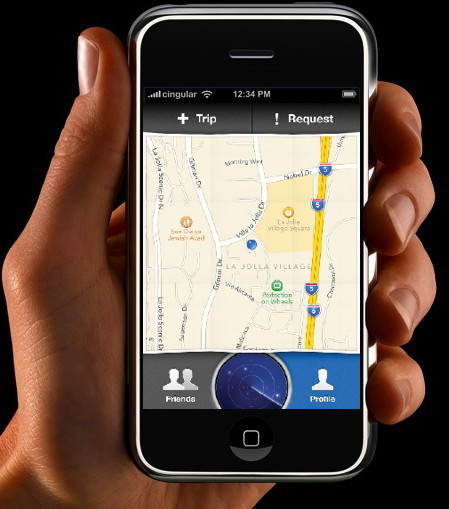
Riding Radar (2010): The early mobile prototype designed to utilize onboard accelerometer hardware for automatic incident detection.
In 2020, the global pandemic created an unexpected window of opportunity. Leveraging my semi-retired status and the sudden abundance of home-bound time, I resurrected these notes and set out to build a modern successor from the ground up: pTreks.
The Architectural Evolution
The original architecture, conceived during our early planning phases around 2020-2021, was designed around Node.js, MongoDB, and React Native to establish a quick, cross-platform proof-of-concept. While this stack was instrumental in proving the feasibility of real-time position sync, we recognized that supporting rigorous, real-world adventure activities demanded far greater performance, transactional safety, and operating-system-level deep hardware access.
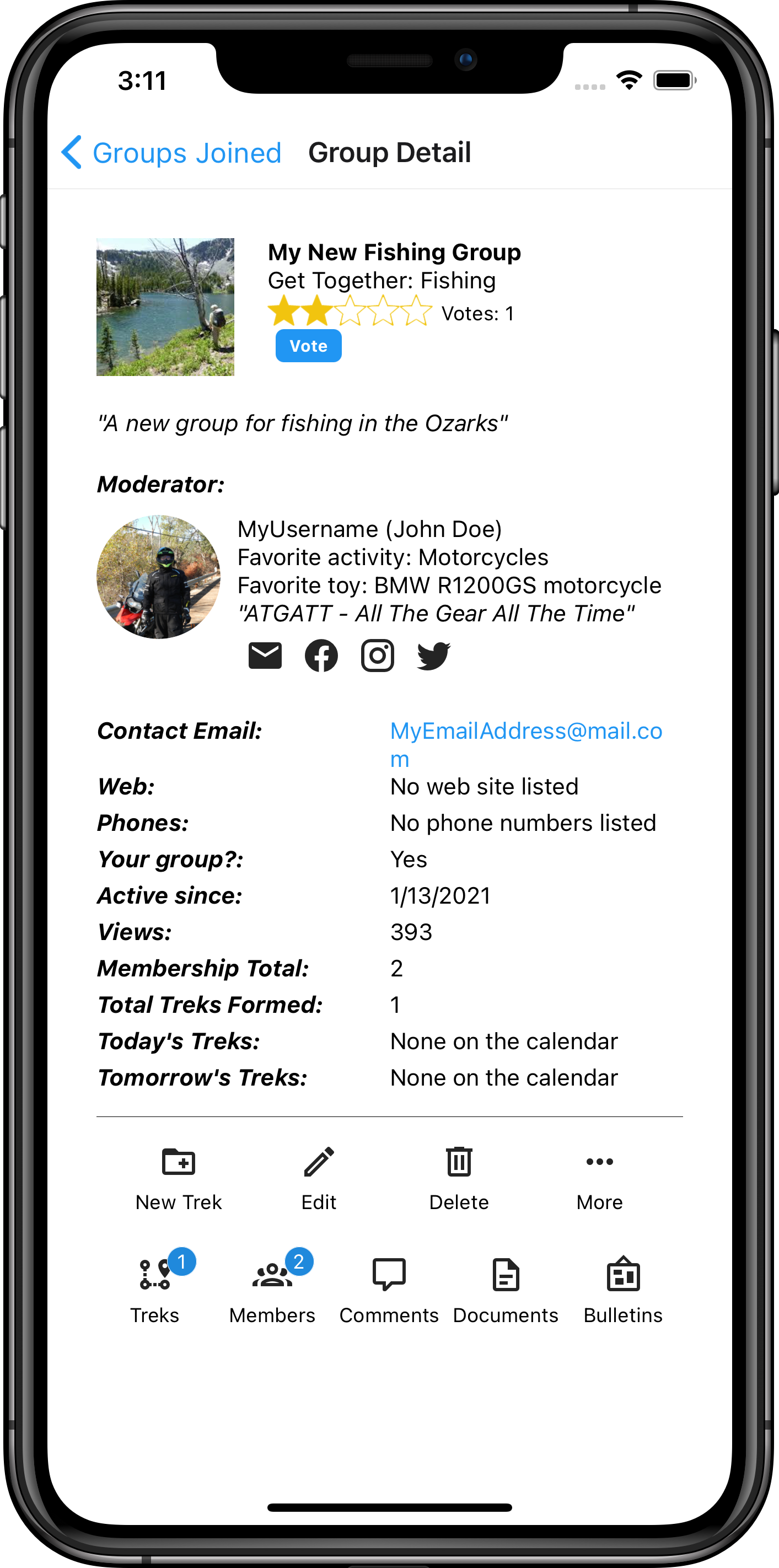
pTreks v2 (2020): Proving real-time synchronization feasibility with a cross-platform proof-of-concept stack.
2022–2025: Modernizing the BMW Owners Club of San Diego
Between 2022 and 2025, my engineering efforts were dedicated to modernizing the digital presence of the BMW Owners Club of San Diego (BMWOCSD). Rebuilding it as a charitable, part-time project during my semi-retirement, I volunteered to reconstruct their website, consolidate member databases, integrate secure payment portals, and streamline their complex weekly calendars, social events, and safety briefings. Working on it a little at a time, the experience proved to be an invaluable practical workshop.
By collaborating closely with hundreds of passionate, high-mileage riders who have toured across the nation and indeed around the world, I gained deep, firsthand insights into the actual, practical mechanics of group dynamics and logistics. I learned exactly what organizers and participants encounter in terms of route planning, real-time status updates, incident response, and team coordination.
Specifically, this experience highlighted the three core tenets of group-riding safety traditionally used to keep large packs coordinated on complex, winding routes:
- The Ride Leader: A designated coordinator who maps the route, sets the operational pacing, and guides the group from the front.
- Posting Corners: A human-network relay protocol in which every rider is responsible for the rider immediately behind them - not for the whole pack at once. When a fork, intersection, or turn that does not follow the natural contours of the road breaks visual contact, that rider stops at the questionable turn and acts as a visible beacon, clearly showing the correct route. The corner is not released by letting followers pass and drifting to the rear; that would break the chain, because the poster would no longer see who is behind. It works only when (1) the poster can see the previously missing rider(s) approach, (2) those riders see the poster and understand which way to continue, and (3) the poster moves forward again before the follower commits to the turn - restoring sight and responsibility for whoever is next behind. If the approaching rider still cannot see the rider behind them, that rider becomes the next poster: they wait at the same corner, act as the visible beacon, and perform the same protocol until their own follower is in sight and properly directed. Everyone is responsible for the person behind them. Each rider must know whether anyone is still following: if yes, they are the leader of a small sub-group and must post when that follower is not visible; if no - as with the sweep rider - posting is unnecessary. In practice, everyone is simultaneously a link in the relay and the leader of their own fraction of the pack.
- The Sweep Rider: The final participant who acts as the rear guard, monitoring the tail of the group, assisting any riders delayed by mechanical issues or minor mishaps, and communicating group status forward.
In traditional touring, safety relies entirely on this human chain - if a single rider fails to post a corner when visual contact is lost, the network breaks. We realized that pTreks could synthesize these exact operational tenets into a digital, automated framework. By tracking coordinates, geofences, and active metrics in real-time, the platform operates as an electronic leader, corner-poster, and sweep, letting everyone monitor the entire group’s positions on a shared map and instantly alerting the team if a rider goes quiet or falls behind.
This profound educational phase served as the ultimate catalyst. While incubated within a motorcycle riding circle, I recognized instantly that these dynamics are thoroughly universal; identical logistical burdens, positional blind spots, and navigational frictions apply explicitly across hiking teams, cycling packs, backcountry skiing groups, and motorcycling collectives alike. In 2025, with a clear, battle-tested vision of what cross-functional group coordination software must execute to remain highly indispensable in the wild, I resumed development of pTreks in earnest.
For our current 2025/2026 production release (v3), we completely re-engineered our platform:
- Native Mobile Clients: We replaced React Native with fully native implementations - Swift for iOS (SwiftUI) and Kotlin for Android. This allows pTreks to run natively with absolute performance, utilizing dedicated system geofencing, hardware sensors, and highly accurate background geolocations.
- Relational Spatial Database: We migrated from MongoDB to PostgreSQL to handle our high-performance relational and spatial data requirements. This ensures rigorous transactional integrity and blazing-fast coordinate queries.
- Real-Time Backend: We maintained our reliable Node.js with Express backend services, paired with WebSockets for seamless real-time location streaming and instant group communications.
- Web Dashboard: We deployed a highly responsive React application dashboard, enabling “View-Only” trek participants and organizers to join in and track active trips in real-time from desktop computers at home.
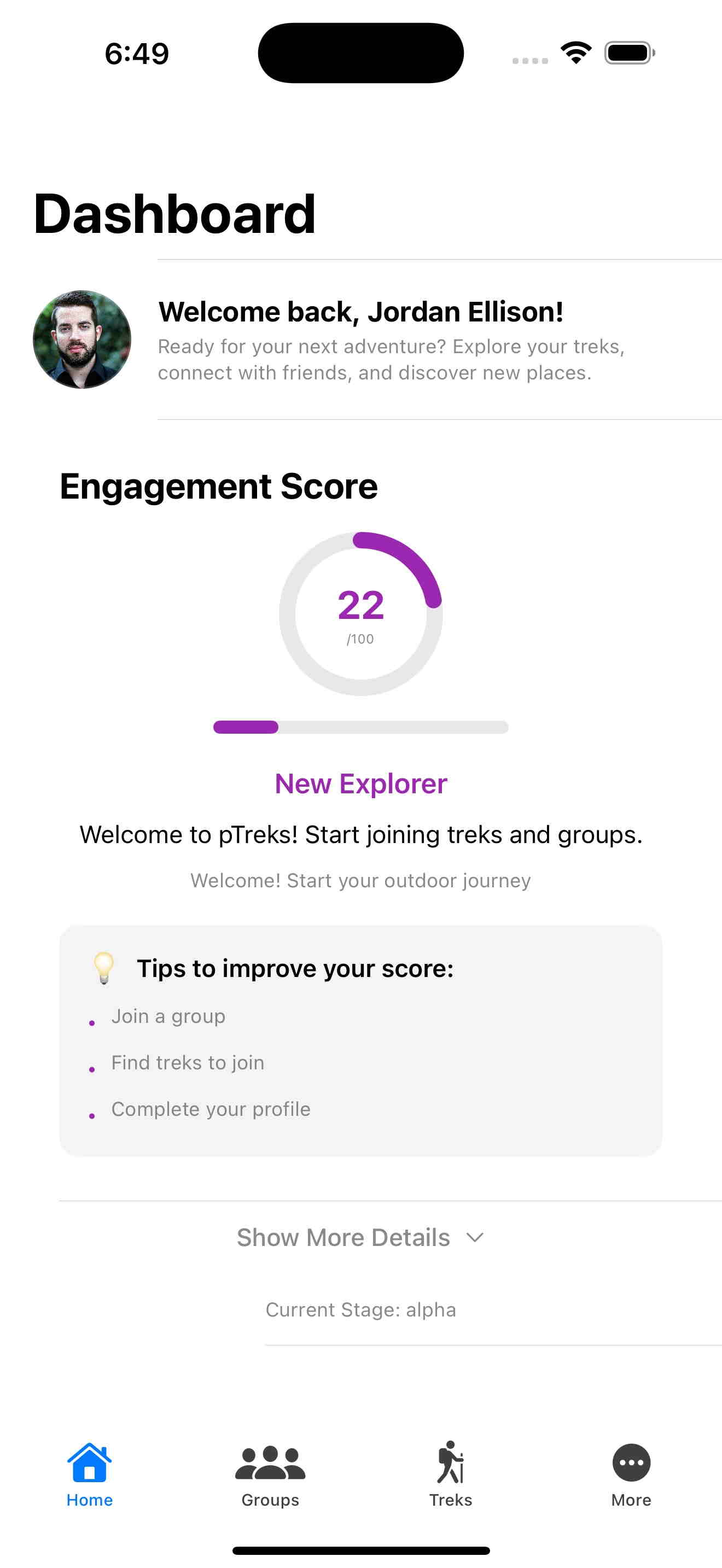
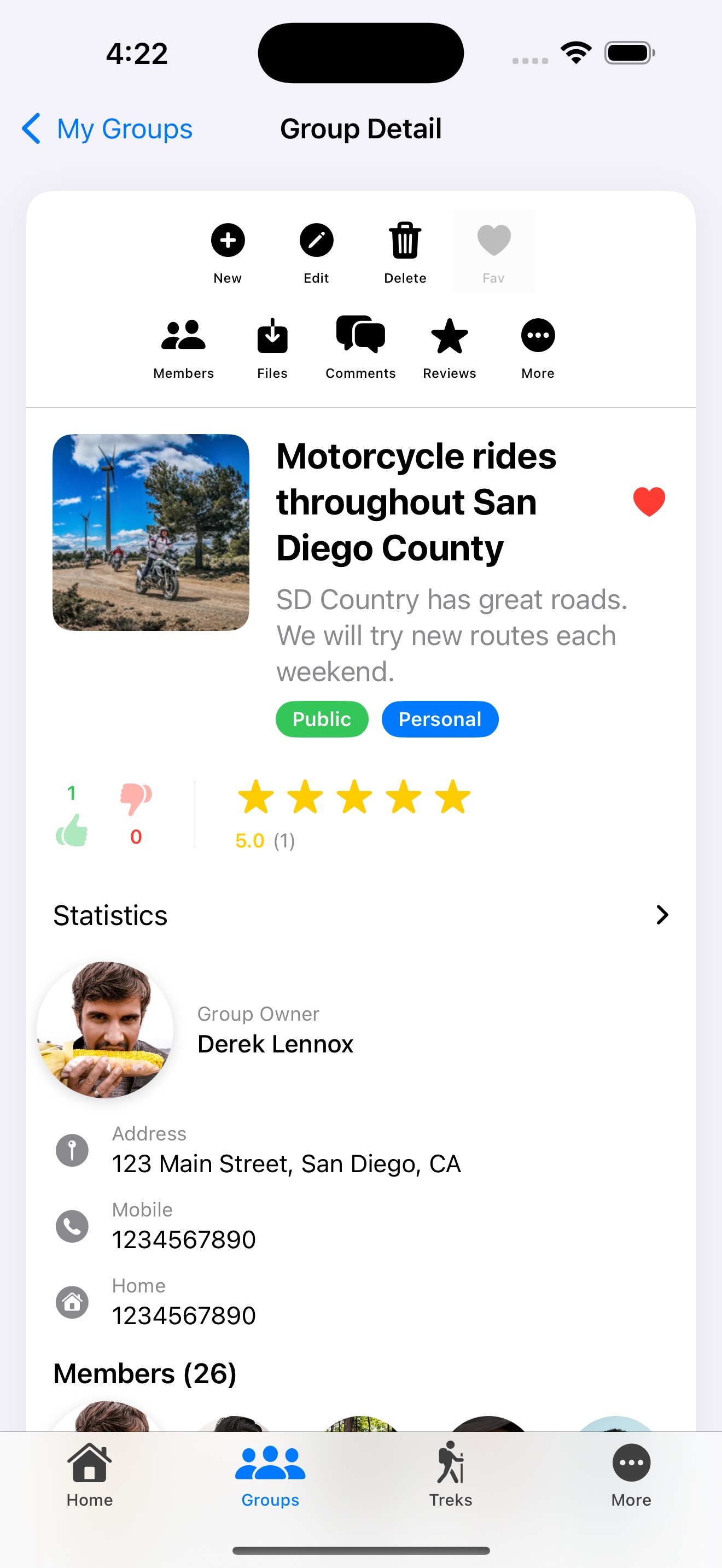
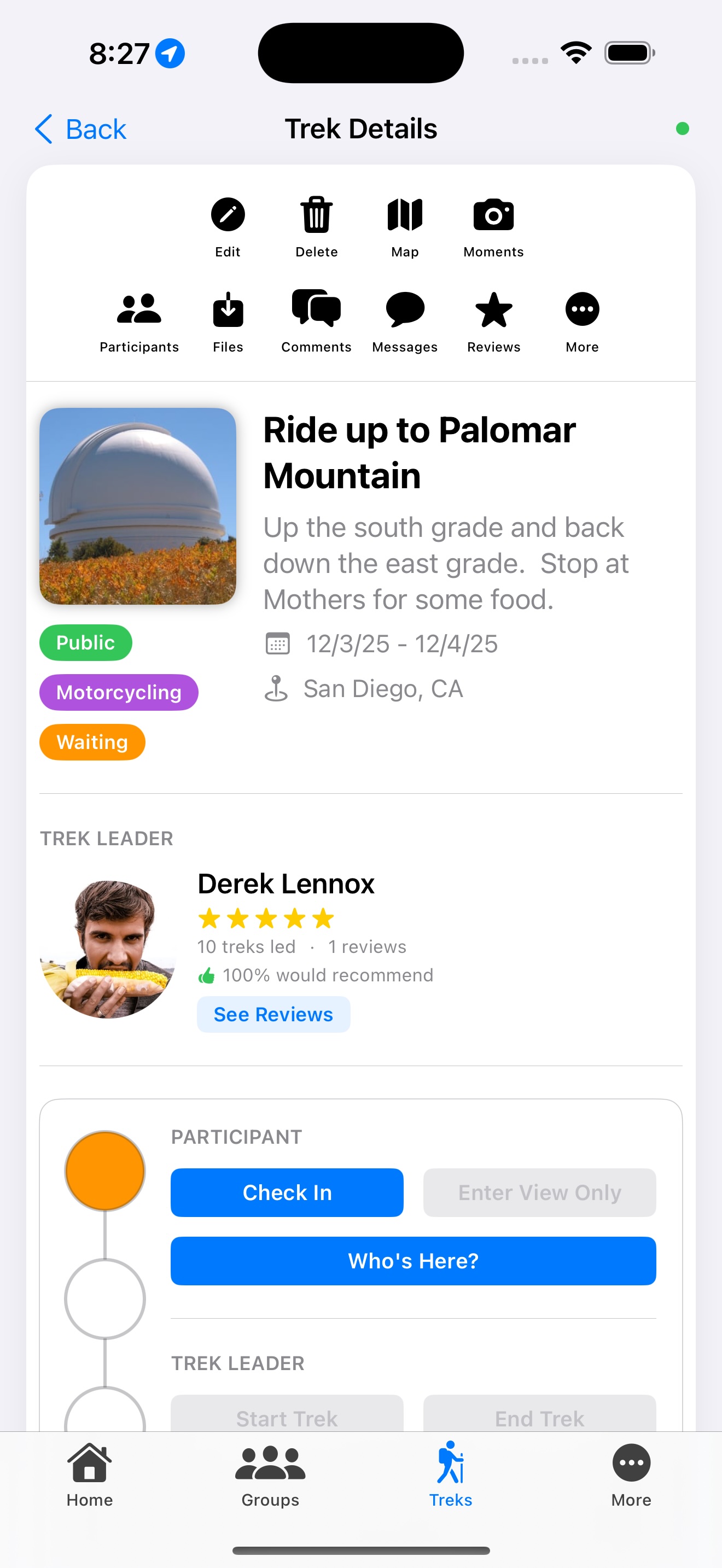
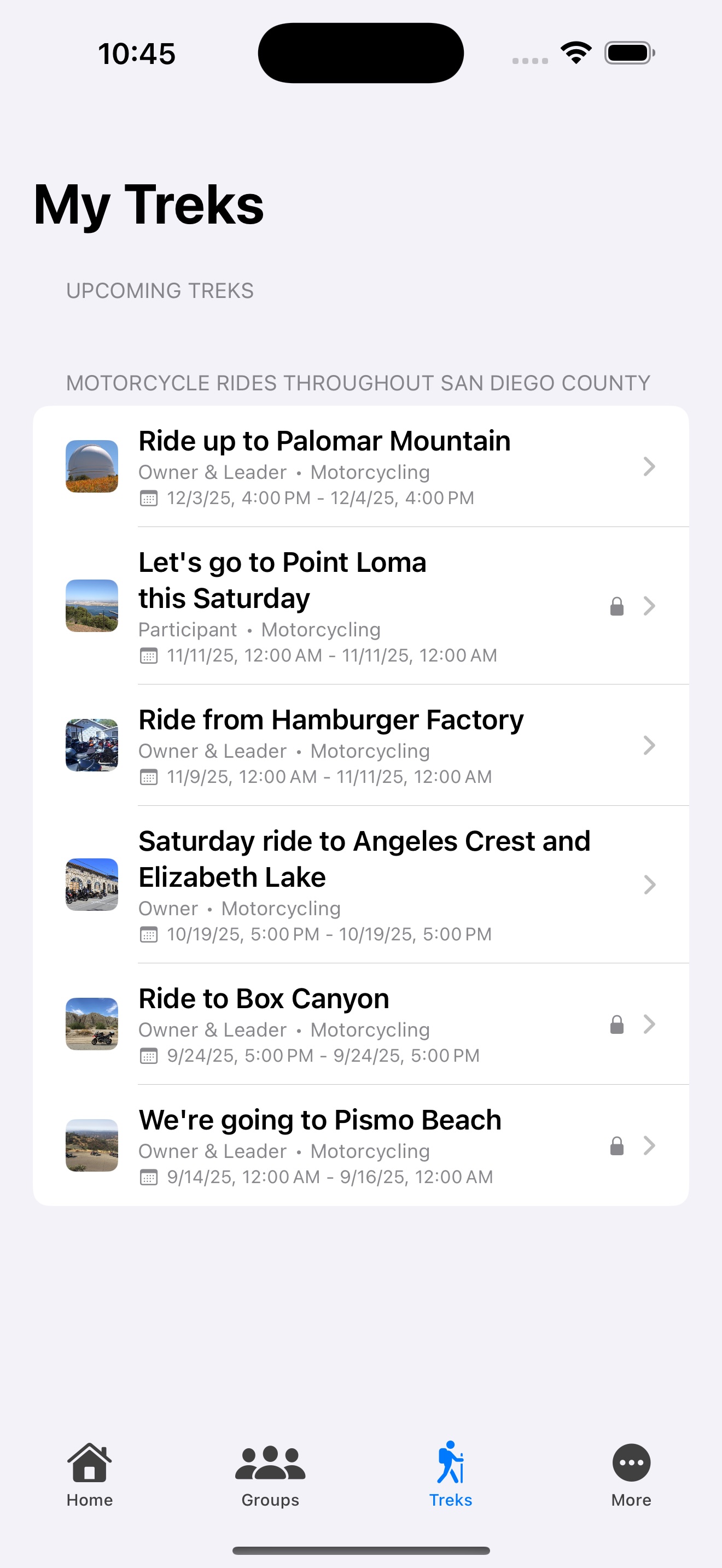
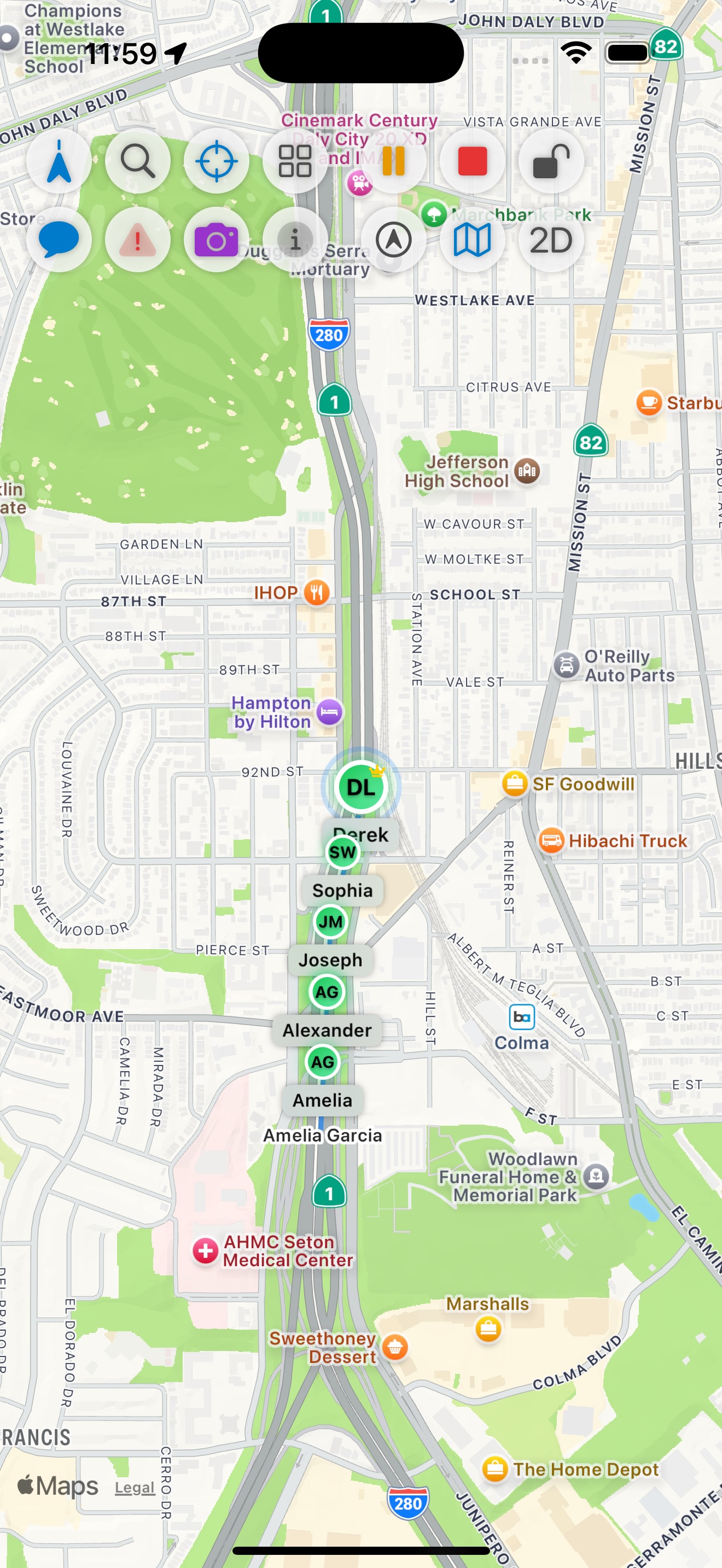
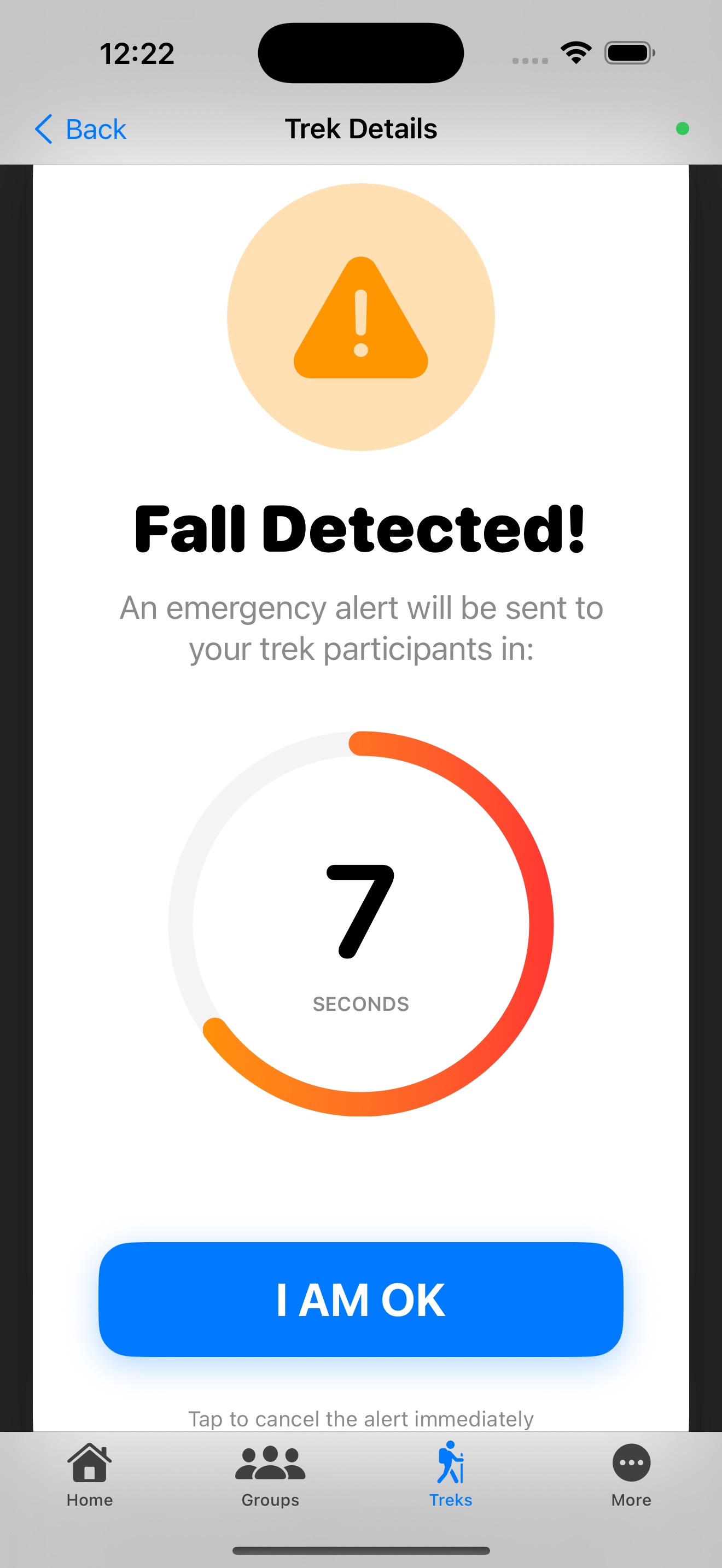
The pTreks Mobile Interface: Seamless real-time coordination, group directories, geofencing, and automatic safety tracking in the palm of your hand.
This transition from hybrid to native clients and from document-based to relational spatial storage was highly demanding, requiring months of meticulous engineering, but it represents our commitment to providing a premium, bulletproof adventure coordination package.
3. Understanding the Framework: Groups vs. Treks
To facilitate this vision across highly diverse activity domains, pTreks uses two core logical pillars to arrange communities and plan events: Groups and Treks.
- Groups (The Community Hubs): A Group represents the permanent home base for a collection of participants who share parallel interests - be it a local Weekend Hiking Club, a Regional Cycling Collective, or your immediate family. Groups secure the long-term roster, hold global chats, and govern ongoing membership outside of active excursions.
- Treks (The Live Active Events): A Trek represents the actual, physical adventure instantiated in reality. Created within the parent scope of a Group, a Trek operates with definitive schedules, unique maps, and localized messaging caches. Only when participants opt into a specific Trek do active GPS sync triggers engage.
Essentially, participants reside perpetually in their corresponding Group, while they stage, communicate, and execute safe tactical field coverage inside individual Treks.
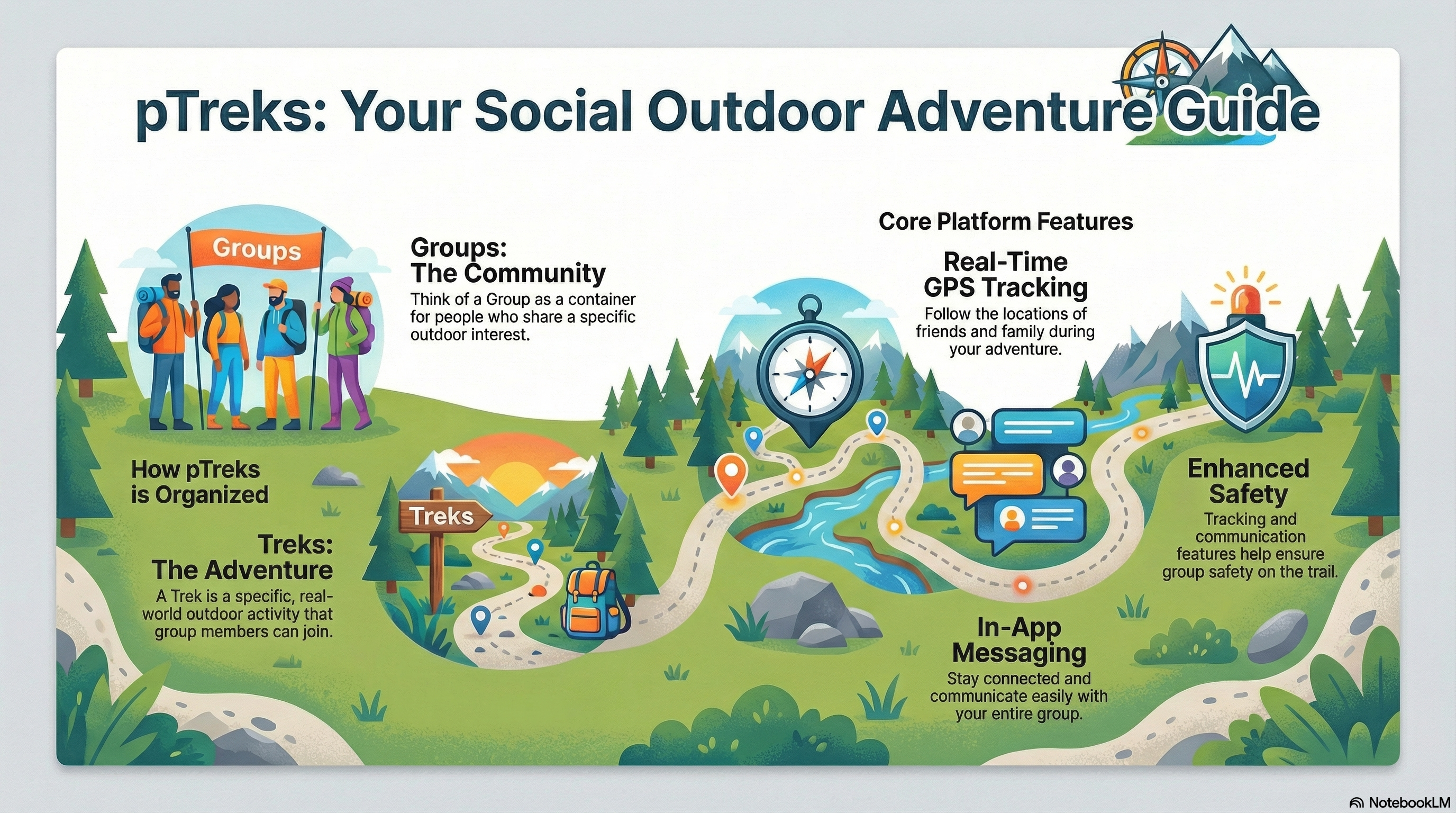
pTreks: Your Social Outdoor Adventure framework for unified group coordination.
4. Our Philosophical Ethos: “Going places by yourself… surrounded by friends”
At its core, pTreks revolves around a singular driving philosophy: “Going places by yourself… surrounded by friends.”
Beyond raw engineering specifications, our absolute priority lies in bridging diverse communities together through unifying outdoor ventures. We acknowledge that explorers deeply cherish their intrinsic autonomy and personal solitude in the elements. We never intend to crowd that sensory freedom, but to construct a highly responsive, invisible safety canopy encapsulating it.
To ensure seamless integration without friction, pTreks serves strictly as a real-time peer-to-peer group awareness engine. We work relentlessly optimizing deep background synchronization - guaranteeing software operates silently in shadow while users maximize their presence in the journey. This spatial optimization ensures families, supporters, and teammates secure persistent visibility windows without impacting device lifespan or users’ privacy limits.
While agile enough for routine neighborhood biking circuits or Saturday morning hikers, the platform is coded with the uncompromising rigor requisite of elite response systems. By combining precise spatial telemetry and comprehensive offline adaptability, pTreks preserves absolute situational clarity across every echelon of the mission stack.
Through pTreks, teams efficiently:
- Maintain 360-Degree Awareness: Instantly view the real-time position of every group member on interactive maps.
- Respond Efficiently to Incidents: If a participant falls behind or stops moving, teammates are immediately informed and can calculate the fastest route back to their precise coordinates.
- Unify Communication: Share instant status updates and text-based announcements within a secure, encrypted framework.
- Access Critical Details: Instantly store and view participant In Case of Emergency (ICE) details directly within the active trek interface.
🎥 Feature & Concept Overview: Click the player below to watch a short movie highlighting the key features and the reasons behind creating pTreks (runtime: just under 6 minutes).
pTreks Concept & Features: A high-level overview of our real-time coordination framework and the core problems we set out to solve.
5. Join Our Community
As we continue to expand the pTreks platform across Web, iOS, and Android, we invite you to be part of our journey. If you have captured striking photos or written logs from your recent group adventures - with or without pTreks on the trail - we would love to feature them in upcoming showcases. Simply share your adventures and inspire others to do the same; a guest article or photo story is a wonderful way to pass that spark along. See our Positions Contributor Guide for how to prepare and submit your work. And when you are ready for your next outing, we hope you will consider joining the pTreks community so your group can ride under that invisible safety canopy together.
To become fully immersive participants, we explicitly encourage you to join pTreks today and commence architecting your own high-impact Trek Memories. Native capture features enable user participation to generate stunning photos and visual streams right in the heat of the adventure. The engine seamlessly stitches this imagery directly to discrete geolocation triggers, preserving exact positional context in the ultimate group scrapbook that teammates and supporters abroad can enjoy indefinitely.
6. Alpha & Beta Testing Programs
pTreks is currently undergoing active alpha and beta testing! We are searching for passionate outdoor enthusiasts to help refine our navigation and safety engine. If you possess iOS or Android hardware and would like early access to our platform to influence its future development, we invite you to join our community of testers.
7. The Road Ahead: Upcoming Articles & Editorial Roadmap
This inaugural article marks the very beginning of our adventure journalism here at pTreks! We will be releasing many more deep-dives as we expand the platform. Stay tuned, as we are currently planning specific, detailed features on the following upcoming topics:
- How to use your digital wallet for non-payment features in pTreks: Learn how to leverage secure, offline lockscreen passes and automated trailhead tickets.
- Features of the native iOS app: Exploring how Swift and Apple Core Services drive absolute background tracking reliability.
- Features of the native Android app: Diving into Kotlin optimization and precise Google hardware sensor tracking in the field.
- Features of the web application: Leveraging our React-powered dashboard to organize, analyze, and manage treks from home.
- How to use View-Only mode: Enabling coordinators, supporters, and family members to track your team’s live progress securely from anywhere.
Thank you for your ongoing support and interest in pTreks.

About the Author
Warren G. Young, PhD
Dr. Young holds a PhD in Neurosciences from UCSD and contributes over twenty years of hardware and software engineering expertise alongside his tenure as Director of Neuropharmacology Computing at The Scripps Research Institute. An accomplished serial entrepreneur and technologist, he has served as President, CEO, COO, and CTO across multiple successful biotech ventures including Neurome and 3D Vision Systems. He personally conceptualized, designed, and architected the pTreks platform, merging specialized feedback systems knowledge with high-performance computing to construct bulletproof team environments in the field.